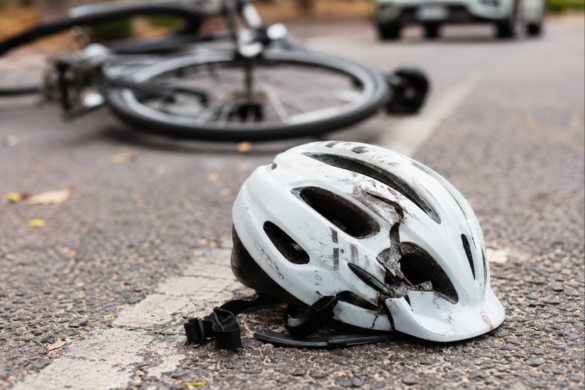
Most cyclists understand that helmets reduce the risk of serious head injuries. That's the entire reason they wear them. Whether riding to work, training for a race, or taking a weekend ride with family, the expectation is simple: if a crash happens, the helmet should perform as advertised.
Unfortunately, that doesn't always happen.
Some helmets fail during impacts they should have been able to withstand. Others contain manufacturing flaws that compromise their protective capabilities long before a rider ever puts them on. When a defective bicycle helmet fails in a crash, the consequences can be catastrophic, leading to concussions, traumatic brain injuries (TBI), skull fractures, and permanent neurological damage.
In these situations, the bicycle accident may not be the only reason a rider was seriously injured. The helmet itself may have contributed to the severity of the harm.
What Happens When a Bicycle Helmet Fails During Impact?
A bicycle helmet is designed to absorb and disperse impact forces before they reach the rider's skull and brain. When that system works properly, it can significantly reduce the severity of head injuries. When it does not, the consequences can be catastrophic.
A bicycle helmet failure can occur in several ways. The outer shell may separate from the foam liner, the retention system may fail to keep the helmet properly positioned during impact, or the protective materials may fracture or compress in a manner that reduces their ability to absorb energy. In some cases, defects are not visible until the moment of impact, when the helmet is subjected to the forces it was designed to withstand.
The result is that more force may be transferred directly to the rider's head than would have occurred if the helmet had performed as intended. Depending on the circumstances, that failure can contribute to concussions, traumatic brain injuries, skull fractures, and other serious neurological injuries.
Signs a Bicycle Helmet May Have Been Defective
Not every serious injury means a helmet was defective. However, certain warning signs often prompt a closer investigation.
These include:
- Cracking during a relatively low-impact collision
- Separation of helmet components during impact
- Broken strap anchors or buckle failures
- Visible manufacturing flaws
- Premature deterioration of materials
- Helmet displacement during a crash despite proper fit
- Performance issues affecting multiple helmets from the same product line
- Safety recalls involving the model involved in the accident
In many bike helmet product liability cases, the defect is not obvious to the rider until engineers and product experts examine the helmet after the crash.
Common Bicycle Helmet Defects That Can Lead to Serious Head Injuries
Not every defective bicycle helmet reaches consumers for the same reason. Some problems originate during the design process, while others arise during manufacturing.
A design-related defect may involve a helmet that lacks sufficient impact protection, uses an inherently flawed retention system, or incorporates safety features that fail to perform under foreseeable crash conditions. In these situations, the problem exists before the first helmet is ever produced. Every helmet built using that design may contain the same safety issue.
Manufacturing defects occur further down the production chain. A helmet may leave the factory with improperly bonded components, defective materials, inconsistent foam density, or assembly errors that compromise its ability to protect a rider during an impact. While the design itself may be sound, mistakes during production can create dangerous products that should never have reached store shelves.
Investigating Whether a Bicycle Helmet Failed
Determining whether a bicycle helmet was defective is rarely as simple as looking at the damage after a crash. In many cases, the investigation involves a detailed examination of how the helmet was designed, manufactured, tested, and ultimately performed during the collision.
Engineers and product experts often begin by analyzing the helmet itself, looking for signs that it failed in a manner inconsistent with its intended safety function. They may examine fracture patterns, material integrity, component failures, impact locations, and other physical evidence that can help explain how the helmet responded to crash forces.
The investigation may also extend beyond the product. Testing records, manufacturing documents, quality control procedures, prior consumer complaints, and evidence of similar incidents can all help establish whether the helmet contained a design defect, manufacturing defect, or other safety issue. The goal is not simply to determine that an injury occurred, but to understand whether the helmet performed as a reasonably safe product should have under the circumstances.
How Do You Prove a Helmet Was Defective?
Unlike a typical bicycle accident claim, proving a defective product case often requires a combination of medical evidence, engineering evidence, and product-specific documentation.
Some of the most valuable evidence may include:
- The damaged helmet
- Product packaging and instructions
- Purchase records
- Photographs of the crash scene
- Medical records
- CT scans and MRI results
- Witness statements
- Product testing reports
- Recall notices
- Internal company documents obtained during litigation
One mistake we frequently see is riders discarding the helmet because they assume it no longer has value. In reality, the helmet may become one of the most important pieces of evidence in the entire case.
The Financial Impact of a Serious Bicycle Accident Brain Injury
The costs associated with a traumatic brain injury often continue long after the initial hospitalization ends. A rider may require months or years of rehabilitation. Some never return to the same profession. Others need ongoing neurological treatment, occupational therapy, cognitive rehabilitation, or in-home assistance. Medical expenses are only part of the equation.
Many families also face:
- Lost income
- Reduced future earning capacity
- Permanent disability
- Long-term care expenses
- Emotional suffering
- Loss of independence
- Changes in family relationships and quality of life
When a defective product contributes to those losses, the financial consequences can be substantial.
Investigating Bicycle Helmet Product Liability Claims
Cases involving defective safety equipment are fundamentally different from ordinary injury claims. The evidence is more technical. The defendants often have significant resources. The investigation frequently involves engineers, product experts, accident reconstruction specialists, and medical professionals working together to determine what happened and why.
At Breit Biniazan, we approach these cases with one objective: uncovering the truth behind the product failure and pursuing the full value of the harm it caused.
Our team investigates whether a faulty bike helmet, bicycle helmet failure, or other product defect contributed to a rider's injuries. We work to preserve evidence, identify responsible parties, and build claims that reflect the true scope of our clients' losses.
When a product designed to protect people instead causes catastrophic harm, holding manufacturers accountable is about more than compensation. It is about exposing dangerous defects, protecting future consumers, and demanding responsibility from the companies that put these products into the marketplace