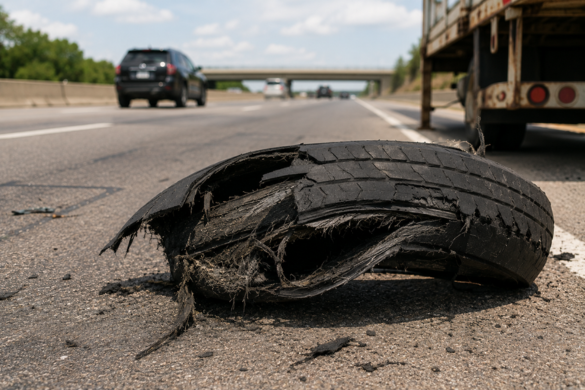
Most drivers do not spend much time thinking about their tires. As long as the tread looks good and the vehicle feels normal on the road, there is little reason to suspect a problem.
That is part of what makes tread separation so dangerous.
A tire can appear completely normal before suddenly coming apart at highway speeds. In a matter of seconds, a driver may lose control of the vehicle, cross into another lane of traffic, or experience a rollover crash. These incidents often leave people wondering whether the tire failed because of something they did or because the product itself was defective.
In some cases, the answer may be found long before the crash occurred.
Manufacturing defects, design flaws, and quality control failures can all contribute to tire failures that place drivers and passengers at risk. When a tire comes apart under normal driving conditions, investigating why it happened is often just as important as investigating the crash itself.
What Is Tire Tread Separation?
Tire tread separation occurs when the outer tread layer begins to detach from the internal structure of the tire. Rather than remaining bonded together as designed, portions of the tire can peel away while the vehicle is in motion.
At lower speeds, a driver may notice vibrations, unusual handling, or noises coming from the vehicle. At highway speeds, the consequences can be far more serious. A sudden tread separation can affect steering, stability, and braking performance, leaving a driver with very little time to react.
Many people refer to these incidents as tire blowouts, but tread separation and blowouts are not always the same thing. A blowout generally involves a rapid loss of air pressure. Tread separation involves the physical breakdown of the tire itself. In some situations, one can lead to the other.
Why Tire Tread Separation Often Leads to Serious Crashes
When drivers lose control because of another vehicle, a distracted driver, or poor road conditions, there is usually at least some opportunity to respond. A tire failure is different.
The vehicle's handling characteristics can change instantly. Drivers may experience violent shaking, a sudden pull in one direction, or difficulty maintaining control. The risk becomes even greater in larger vehicles, SUVs, pickup trucks, and vehicles towing trailers.
Many tread separation crashes involve rollovers because the vehicle becomes unstable during emergency steering corrections. Others result in cross-median collisions, impacts with fixed objects, or multi-vehicle crashes.
Not Every Tire Failure Is Caused by Driver Error
After a serious crash, there is often an assumption that the driver must have done something wrong. While poor maintenance can contribute to tire problems, it is far from the only explanation.
Tires are complex products made from multiple layers of materials that must work together under extreme conditions. They are exposed to heat, pressure, changing road surfaces, and thousands of miles of use. If something goes wrong during the design or manufacturing process, those defects may remain hidden until the tire is subjected to normal driving forces.
In product liability cases involving tire defects, investigators often look at issues such as improper bonding between tire components, defective materials, manufacturing inconsistencies, or design decisions that make the tire more susceptible to failure. These problems may exist long before the tire reaches a consumer.
The fact that a tire failed does not automatically mean it was defective. At the same time, the fact that a driver lost control does not automatically mean the driver was at fault.
Signs a Tire Manufacturer May Be Responsible
Determining whether a tire manufacturer may share responsibility requires a detailed review of the evidence, but certain facts often warrant a closer look. A tire may deserve additional investigation when:
- The tire failed despite routine maintenance and proper inflation
- The vehicle had relatively low mileage on the tire
- Similar failures have been reported involving the same model
- The tire was subject to a recall or safety investigation
- Physical evidence suggests belt separation or bonding failures
- The failure occurred without striking debris, potholes, or other road hazards
The presence of one of these factors does not guarantee that a defect existed. They can, however, indicate that the tire itself deserves closer scrutiny.
How Tire Defect Investigations Work
A defective tire claim is rarely proven through photographs alone. In many cases, the tire itself becomes one of the most important pieces of evidence.
Engineers and product experts may examine the failed tire to determine how the separation occurred and whether the tire performed as it was designed to. The investigation can include reviewing manufacturing records, product testing data, recall history, quality control procedures, and evidence of similar failures involving the same product line.
The goal is not simply to identify that a tire came apart. The goal is to determine why it happened. That distinction matters because the cause of the failure often determines whether responsibility lies with the driver, a third party, or the company that manufactured the product.
Injuries Commonly Associated With Tire Tread Separation Crashes
Tread separation accidents frequently involve high speeds and sudden loss of control, which is one reason the injuries are often severe.
Victims may suffer traumatic brain injuries, spinal cord injuries, multiple fractures, internal organ damage, or permanent disabilities. In rollover crashes, the risk of catastrophic injury increases significantly, particularly when occupants are partially ejected or the roof structure collapses during the collision.
For many families, the effects of these injuries extend well beyond the initial hospitalization. Ongoing medical treatment, rehabilitation, lost income, and permanent limitations can continue for years after the crash.
Who Can Be Held Responsible for a Defective Tire?
Many people assume that liability begins and ends with the tire manufacturer. Depending on the circumstances, the investigation may reveal responsibility extending beyond a single company.
Potentially responsible parties can include manufacturers, component suppliers, distributors, and others involved in bringing the product to market. The facts of each case determine where responsibility ultimately falls.
Product liability laws exist because consumers have no practical way to evaluate a tire's internal construction, manufacturing process, or engineering decisions before purchasing it. Drivers rely on manufacturers to place reasonably safe products into the marketplace.
Why Early Evidence Preservation Matters
One of the biggest mistakes people make after a tire failure is allowing the vehicle to be repaired or the tire to be discarded before it has been properly examined. Once key evidence disappears, determining why the tire failed becomes significantly more difficult.
Preserving the tire, vehicle, maintenance records, photographs, and crash documentation can provide valuable information about whether a defect played a role in the incident. In many cases, evidence that seems insignificant immediately after the crash becomes critical later in the investigation.
How Breit Biniazan Investigates Tire Defect Cases
At Breit Biniazan, we approach tire defect and tread separation cases with the understanding that a product failure can be just as important as the crash itself. Our team works to uncover how the tire was designed, manufactured, tested, and distributed. That often involves reviewing technical evidence, working with engineers and product specialists, and examining whether the manufacturer had prior knowledge of similar failures.
A tire manufacturer may have spent years developing and marketing a product before it ever reached a consumer. We believe the investigation into a catastrophic tire failure should be just as thorough. When a defective product contributes to a serious crash, identifying the cause is often the first step toward holding the responsible parties accountable.